

2019-08-30T05:52:49
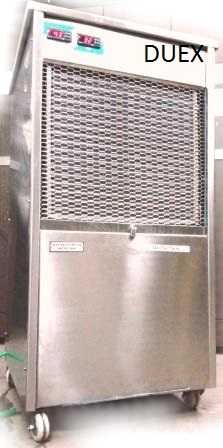
Dehumidifier DUEX Dehumdiifier caters to Pharma and Engineering industry It has various models for different area coverage and applications. FAQ- Dehumidifier Rust, corrosion, oxidation, tarnish of tools, electronic, computer and other valuable equipment, coin collections, silverware mildew, fungus, mold, odor, spoilage spotting, toning, stains, gum damage, cracks to stamp collections and valuable documents, photographs, videos shortened "shelf-life" of photographic film, batteries, fogging of lenses deterioration of foods, medicines, etc. It's worth it to do your best to make the protected area as vapor-proof as possible. 1. What is Relative Humidity? Atmospheric air is a mixture of various gases and water vapor. The invisible water vapor in the air is called humidity. The amount of water that can be contained in a pound of air depends upon • Temperature of the air • Pressure of the air At a constant pressure, the warmer the air the more water vapor it can retain. If air at a certain temperature has absorbed all the moisture it can hold at that temperature, it is said to be saturated. The amount of water present, or the degree of saturation is evaluated in terms of Relative Humidity or Saturation ratio. Hence, Relative Humidity is the actual water content in % of that of a saturated volume. When air is 50% saturated, it contains only one half the amount of water than it can contain at the same temperature and pressure. As the relative humidity approaches 100%, the air can take on less and less moisture and at 100% relative humidity, that air cannot hold more water. If air is saturated with water vapor at a given temperature, a drop in the temperature will lead to condensation of water in the form of droplets. The temperature at which moisture condenses out is the dewpoint temperature. 2. How do you measure Relative Humidity? Relative Humidity is determined by means of wet bulb and dry bulb thermometers. The dry bulb temperature is the temperature of air as determined by a standard thermometer. The wet bulb temperature is determined by tying a wet wick over the bulb dipped in a reservoir containing distilled water. Airflow around the wick causes the evaporation of moisture thus lowering the temperature and producing a reading lower than that on the dry bulb thermometer. The comparison between the two readings gives us the measurement of water vapor in the air. 1. The lesser the difference - the wetter the air. 2. The greater the difference - The dryer the air. The readings can be plotted on a chart known as the psychrometric chart from where the properties of air vapour mixture like relative humidity, absolute humidity, dewpoint can be directly determined. 3. How Humidity Affects Industry? Humidity is a constant threat to production efficiency and product quality. The damage which can be caused by excessive relative humidity are principally:- - corrosion of steel and metals - deteriorated characteristics of hygroscopic material - increased harmful activity of micro organisms. 4. What are the typical methods of dehumidification? Principally there are three methods of dehumidification:- ... Over compression ... Refrigeration Dehumidification ... Sorption Dehumidification (silica gel, desiccant rotor) 5. How can Compression be used to dry the air? Air compression suggests a method of reducing moisture content in air. As air is compressed, partial pressure of the water vapor in the water gas mixture rises to the point where moisture can be condensed from the air at a higher temperature. This approach is some times quite practical for very small volumes of air but the cost of compressed air equipment, BHP requirement and the amount of cooling water required for after-cooling makes it very impractical for large volumes of air. 6. How can Refrigeration be used to dry the air? Another method most commonly employed is the reduction of moisture in the air by means of reducing the temperature. By examination of the dew point alone or saturation curve on the psychometric chart. It can readily be seen that as the temperature of the air is lowered, the amount of moisture it can hold is reduced considerably. Thus by cooling the air below the dew point, the moisture contained in that air can be condensed out and some of the moisture vapor removed in liquid form, but cooling to very low temperature makes the refrigeration process impractical, as it requires a great deal of subsequent re-heating and so cost involved. The reduction in air temperature is also limited by the freezing point of water condensing on the cooling coil, which in some designs is offset by complicated brine spray and liquid lithium chloride type systems available using a combination of refrigeration and adsorbent liquid. These are very bulky and involve complicated control systems for the proper maintenance of solution density. 7. How is the dehumidification equipment sized? To size the equipment, it is first necessary to correctly estimate the moisture load. At low humidity, water vapor will permeate at very significant rate and large quantity based on vapor pressure difference. As ASHRAE has not laid out moisture estimation procedures for low humidity requirements, most air conditioning engineers are not fully equipped to correctly estimate the moisture load. Once the moisture load has been correctly estimated the sizing of the dehumidifier is a relatively simpler task. 8. Is there any quick thumb rule applicable for determining the equipment selection? NO. The moisture load in a particular area is directly influenced by: a) The volume of the room b) Outside absolute humidity c) Inside absolute humidity to be maintained d) The vapor pressure resulting from the difference between b) and c) above e) The rate of migration of vapor resulting from d) above i.e. vapor pressure difference f) Conveyor openings, if any g) Door size and door openings per hour h) Number of people and their activity level i) The fresh air quantity All of these can significantly change the dehumidifier equipment selection for the same size room. 9. Will the relative humidity being maintained inside an environment, with the help of dehumidifier, vary from season to season, depending upon the ambient temperature? OR What are the controls used to maintain the desired RH, when there is a wide variation in ambient temperatures and RH? Like any refrigeration plant the load on the dehumidifier system varies due to ambient conditions. The temperature control is maintained by AHU/ Split AC. The RH control is achieved with the help of humidistat or a proportionate RH controller. There are several control option for optimizing dehumidifier equipment energy/performance by one or more of many methods like proportionate reactivation energy, switching on and off the reactivation energy, switching off the dehumidifier, switching off the rotary bed and the reactivation energy and keeping the air flows on, etc. 10. Is the equipment fire safe, especially where inflammable or ignitable material is stored? YES. Dehumidifier equipment can be easily supplied with flameproof motors and controls to make it suitable for hazardous areas and flame proof/explosive proof applications. The DUEX® Dehumidifier incorporates inflammable, imported metal silicate desiccant synthesized rotor. 11. What are the common maintenance problems with dehumidifier? Are the spares and consumables available easily? YES. DUEX® dehumidifiers are easy to maintain and do not require special skills either to operate or to maintain them. Elaborate maintenance manuals provide easy to follow instructions for installation, start-up and also a comprehensive trouble shooting guide. DUEX® also offers training programmes for service technicians, maintenance staff of user organizations, from time to time, to familiarize them with the operation and maintenance of the dehumidifier. 12. What are the common problems caused by moisture? Rust, mold, mildew, rot, decay, warping, stretching, lumping, caking, agglomeration and decomposition are all common enough problems encountered in our daily life. It is interesting to note that the root cause of all these problems and many more, is the presence of moisture or humidity in the air. The storage, manufacture and transportation of material often takes place in a humid environment which is not suited to the moisture sensitivity of the material, leading to deterioration of stored material, machinery, equipment and reduced product appeal. Humidity makes for mushy transfers in the printing industry and irregular operation of packaging machines. Seeds lose their germinating potential and dry fertilizers agglomerate. In pumping stations and high voltage rooms, expensive installations may rust as a result of unchecked condensation. 13. What are the problems caused by moisture in the Pharmaceutical industry? In the Pharmaceutical Industry, chemists have common problems of caking, lumping decomposition and difficulty in compression of tablets leading to breaking of tablets; lumping and caking of dry powders, improper adhesion under pressure of tablets, improper drying of gelatin capsules. The presence of high humidity in the air is the cause of all these problems. The rapid advance in the discovery, manufacture and use of modern drugs has focused attention on an infinite number of moisture control problems. Too much moisture in the air may retard the growth of certain organic cultures. At the very least, shelf life is particularly shortened by the presence of humidity during the manufacturing process. 14. What are the problems caused by moisture in the Food industry? Potato chips, dry breakfast cereals and soda crackers exhibit an affinity for water when exposed to high humid conditions and will become soggy and unappetizing. In processing of powdery foods such as cocoas, gelatins, the sticking or lumping of powder due to high humidity conditions prevents its flow in the manufacturing process. 15. What are the problems caused by moisture in the Wood/Bamboo industry? Major problems faced by wood industry are splitting, dimensional changes, distortion, case hardening, straining, discoloration, warping and other forms of degradation that diminish its quality and there by its quality and selling price. Wood/ bamboo is essentially process of drying it close to the Equilibrium Moisture Content (EMC) in ambient/surrounding of the place of its final usage. 16. What are the problems caused by moisture in the Electronic industry? In the electronic industry, wirings on PCBs gets corroded or short circuited due to presence of high humidity. Transistors may break down or suffer a decrease in longevity and for wafer production facilities the uniform growth of crystals is unachievable. 17. When packing products, we have a problem with water condensing in the package. Is there a simple way to avoid this? This is common when packing cold products in a warmer environment, where the relative humidity, i.e. moisture content, is too high. This causes the moisture in the air to condense on the product's cold surface. 1. Make sure the dew point of the air surrounding the product is below surface temperature of the product by enveloping the packaging equipment and dehumidified air into the envelope or shroud. 18. When transporting powders, we have persistent problems like sticking and caking. Why? Powders are generally very hygroscopic, meaning they absorb moisture easily. A preferred solution is to lower the relative humidity in areas where the powder is processed and also if conveying powders with air, dry the air to avoid absorption of moisture by powder during conveying. 19. Will a Dehumidifier prevent mould growth? Yes. Mould growth appears on continually damp areas. A dehumidifier will remove the moisture that is the root cause. 20.What is Corrosion? Corrosion is defined as destruction of a metal or alloy by chemical or electrochemical reaction with its environment. In most instances, the reaction is electrochemical in nature: a flow of electricity between certain areas of a metal surface through a solution capable of conducting an electric current. This electrochemical action causes destructive alteration (eating away) of a metal at areas. Though corrosion is a complex function of many factors, the three most important are- - a voltage differential between pure and impure areas - physical conditions of temperature and humidity - and oxygen in the air. Higher humidity may lead to higher condensation of water on the metal surfaces. The concentration of molecules of water vapor increases with increasing RH. This molecular thickness of the layers of water eventually permits ionic conduction, which accelerates the rate of corrosion. With iron or steel, the ferrous ion may react with hydroxyl ion in water to form ferrous hydroxide and with oxygen to produce ferric hydroxide (rust). The rate of corrosion is faster where surfaces are exposed to polluted air in combination with high relative humidity. Industrial pollutants like sulphur dioxide enhance the corrosion rate. Corrosion or rusting of stored material can be seen in every Industry-Defence, Marine, Precision parts etc. DDC-200/DDE-200 M: 9324082483 E: duexindustrialsystems@gmail.com
Have a question? Ask here!
Required fields are marked *